How To Change Attribution Model In Google Ads
In this post, you will learn how you can change attribution model in google ads and what impact on conversions by changing the attribution model.
Read more →
Book a free audit call and we will tell you which lever moves your numbers first.
Book a free auditMost Google Ads accounts are quietly leaking money. The clicks keep coming, the budget keeps spending, and everything looks fine. But underneath, three or four broken settings are burning cash every single day. This Google Ads checklist fixes that, whether you are setting up a brand new account or optimizing one that already runs.
Use it two ways. First, the setup checklist gets a new campaign built the right way. Then the daily, weekly, and monthly optimization checklist keeps it healthy so it climbs instead of stalls. No jargon, no fluff, just the tasks that actually move results. (Searching for the “optimisation” spelling? Same guide, this covers both.)
Here is the whole thing at a glance. Each item is broken down below.
Setup checklist (do once, in order):
Optimization checklist (repeat forever):
Start Here: The One Thing Most People Skip
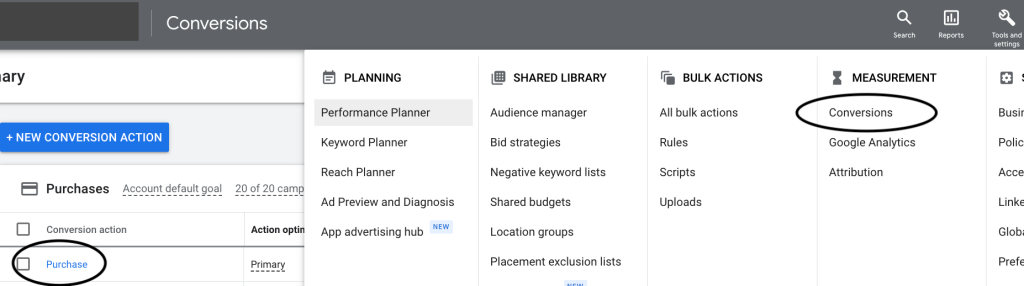
Before you touch keywords, budgets, or fancy ad copy, fix your conversion tracking first. This is the top item on any serious Google Ads setup checklist for a reason.
A conversion is any action you want a visitor to take: a sale, a phone call, a form fill, a sign-up. If Google does not know which clicks led to those actions, it cannot find more people like your buyers. It is like asking someone to hit a target blindfolded.
Why this matters more than anything else:
Action step: Label your most important conversion (usually a purchase or a real lead) as your primary conversion. Mark smaller stuff like newsletter sign-ups as secondary. Then test it. Make a test purchase or fill out your own form and confirm it shows up.
Get this one thing wrong and the other 17 steps below won’t save you. This is why a google ads conversion checklist always starts here.
Covered above, but it earns the top spot. No tracking, no progress. Set it up, test it, and confirm the numbers look real before spending real money.
Google offers several campaign types. Beginners often pick the wrong one and wonder why results are messy. In plain English:
Beginner tip: Start with a Search campaign. It is the easiest to control and the easiest to learn from.
A messy account is the number one reason campaigns underperform. Think of your account like a tidy closet, everything in its place. This is the backbone of any good google ads campaign checklist.
Rule of thumb: if a friend looked at your account and couldn’t figure out the naming in five minutes, it is too messy.
You set a daily budget, and Google spreads your spend across the day. Some days it spends a little more, some less, but it averages out across the month.
Bidding is how you tell Google what you are willing to pay. In 2026, most of this is automated (called Smart Bidding), and that is usually a good thing once your tracking is solid.
Simple guide:
Smart Bidding works best with at least 30 conversions per campaign per month. Below that, the AI struggles to learn. Clean data in, good results out.
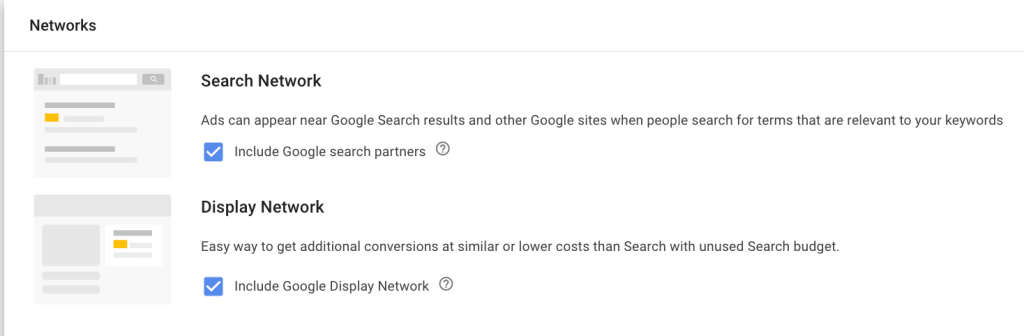
Do not pay to show ads in places you can’t serve.
Keywords are the words people type into Google. The trick is picking words from people who are ready to act, not just curious.
Think about where the searcher’s head is at:
Use Google’s free Keyword Planner to find ideas and check how often people search them.
This one quietly controls how much money you waste. Match types tell Google how loosely to match your keyword to real searches.
[running shoes] shows for very close searches. Tightest control. Best for proven winners."running shoes" shows for searches that include your phrase. A solid middle ground.running shoes shows for anything Google thinks is related. Use only to discover new ideas, and only with a strong negative list watching it.Beginner tip: Start with phrase and exact match. Add broad match later, carefully.
Negative keywords are searches you block. This is one of the fastest ways to stop wasted spend, and most beginners skip it.
If you sell premium products, block words like “free,” “cheap,” or “DIY.” If you sell new items, block “used” and “refurbished.” You will keep adding to this list every week (more on that below).
The standard search ad today is the Responsive Search Ad (RSA). You give Google a pile of headlines and descriptions, and its AI mixes them to find the best combos.
The real limits, straight from current specs:
What actually works:
Assets are the extra bits that make your ad bigger and more clickable, for free. A bigger ad pushes competitors down the page.
Add these:
More space on screen usually means a higher click rate, and a higher click rate often means cheaper clicks.
Your landing page is where people go after they click. If the ad promises one thing and the page shows another, people bounce, and you still paid for the click.
Quick landing page check:
Performance Max is powerful but it will spend wherever it wants unless you set limits. Left alone, it often steals credit from your brand searches and shows ads in low-quality spots.
Before you run PMax:
A few default settings quietly waste money. Track them down:
Setup is a one-time job. Optimization never stops. The accounts that climb to the top of Google all share one habit: a regular routine. Here is the optimization checklist split by how often each task should happen, so nothing slips through.
A realistic time budget for most accounts: about 15 minutes daily, 1 to 2 hours weekly, and 2 to 4 hours monthly.
A quick health check, not a deep dive. You are just looking for fires.
This is where the real money is saved. The single most valuable weekly task is search terms work.
This one report, cleaned weekly, has a compounding effect. Cleaner traffic means a higher click-through rate, which means cheaper clicks over time.
Zoom out to 30, 60, or 90 days and look at trends, not single days.
Every 90 days, do a full review.
Even careful advertisers fall into these traps:
Conversion tracking. If Google can’t see which clicks lead to sales or leads, it can’t optimize, and every report becomes unreliable. Set it up, test it, and confirm it works before anything else.
A setup checklist is a one-time list to build a campaign correctly: tracking, structure, keywords, ads. An optimization checklist is a repeating routine (daily, weekly, monthly) that keeps the account healthy and improving after launch.
Plan for about 15 minutes daily for a health check, 1 to 2 hours weekly for search terms and bid work, and 2 to 4 hours monthly for strategy. Run a full audit every quarter.
Reviewing the search terms report. Block irrelevant searches as negatives and add high-performing searches as exact-match keywords. Done consistently, it compounds and lifts your whole account.
You can add up to 15 headlines and 4 descriptions, but 8 to 10 strong, varied headlines usually perform better than forcing all 15. Only about 3 headlines and 2 descriptions show to any single person.
Yes. Google renamed AdWords to Google Ads back in 2018. If you still search “google adwords checklist,” this same guide applies. The platform is the same, just with a newer name and many new features like Performance Max.
It can work, but it needs guardrails: account-level negatives, audience signals, and a brand exclusion if you run a separate brand campaign. Many beginners get cleaner, easier-to-learn results starting with a Search campaign first.
Start with a budget small enough that a slow week won’t hurt, but large enough to gather data, often a modest daily amount on one focused Search campaign. Scale up only the parts that prove they work.
A winning Google Ads campaign isn’t built on luck or a big budget. It’s built on clean tracking, a tidy structure, sharp keywords, and a routine of trimming waste. Work through the setup checklist once, then run the daily, weekly, and monthly optimization checklist forever.
Your next step: Open your Google Ads account right now and check item number one, your conversion tracking. If it’s broken, nothing else matters until it’s fixed. Start there, then work down the list.
We set up tracking, run the ads and fix the funnel for D2C brands — so guides like this one become someone else's job.
In this post, you will learn how you can change attribution model in google ads and what impact on conversions by changing the attribution model.
Read more →
If you are new and don't know how to connect your merchant centre with your Google Ads Account, don't worry we will cover everything in this post. It will
Read more →
Are you running Google Ads or Facebook Ads for your eCommerce Store? If yes, then you might be only focusing on the conversion, rather than Profit you are
Read more →