Hair care · Shopify
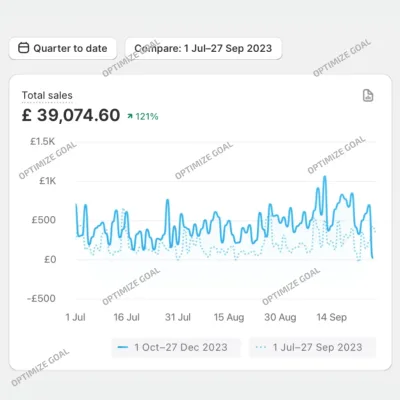
£5K to £39K in four months
Revenue had stalled. We fixed the site experience and launched UGC problem-solution ads — the quarter closed up 121% on the one before.
- 2.5x ROAS
- +121% QoQ

Book a free audit call and we will tell you which lever moves your numbers first.
Book a free auditMeta advertising for ecommerce brands: consolidated account structure, weekly creative testing, and CAPI tracking wired to real orders so the algorithm optimizes on purchases it can actually see. Book the free audit call and within 48 hours you get a written read on where your Meta spend is leaking and which creative to test next.
30 minutes · With the senior buyer who would run your account · Findings in 48 hours
Trusted by 50+ D2C brand founders


A Facebook ads agency plans, builds, tests and scales paid campaigns across Facebook and Instagram, and is accountable for the revenue those campaigns produce against what they cost — covering strategy, creative, account structure, tracking and reporting.
The job changed considerably in recent years, and agencies that did not change with it are still selling the old version. Detailed interest targeting used to be the craft; Meta's machine learning now handles most audience selection better than manual segmentation does. What still requires human judgment is what the ads say and show, how the account is structured so the algorithm receives clean signal, and whether the conversion data being fed back is true. That is the work a Facebook and Instagram ads agency for ecommerce should be judged on now: creative, structure and signal, in roughly that order.
Creative is where the leverage moved. On Meta, the creative is effectively the targeting — the hook decides who stops scrolling, and therefore who the algorithm learns to find more of. That makes creative volume and a testing method more valuable than audience tinkering. We run structured tests on angles, hooks and formats on a weekly cadence, so winners are found by process rather than by one person's instinct, and so a fatiguing ad is replaced before the cost per acquisition drifts up.
Account structure matters in the opposite direction to intuition. The reflex is to split budget into many ad sets for control, which fragments conversion data across too many small pools and stops any of them exiting the learning phase. Consolidated campaigns concentrate signal so Meta can actually optimize, and Advantage+ Shopping campaigns work well precisely when they are given clean data and a strong creative pool rather than being micromanaged.
Underneath it all sits tracking, which is where a great many Meta accounts quietly fail. Browser pixels lose a meaningful share of purchases to tracking prevention, so the platform underreports, and brands cut campaigns that were profitable. Conversions API wired to real orders, deduplicated against the browser event, is what lets the algorithm optimize on purchases that actually happened. Then results get reported blended — spend against total store revenue — because platform ROAS counts the same sale several times and a bank balance does not.
We check your Pixel and Conversions API against real orders, find the creative that is fatiguing, and send back in writing where your spend is leaking within 48 hours.
Revenue had stalled. We fixed the site experience and launched UGC problem-solution ads — the quarter closed up 121% on the one before.
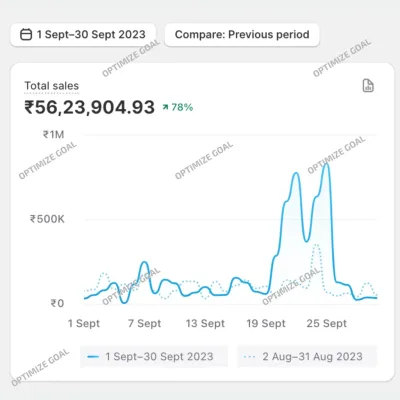
No funnel structure and a flat account. We rebuilt campaigns around a small set of offers and let the winners take the budget.
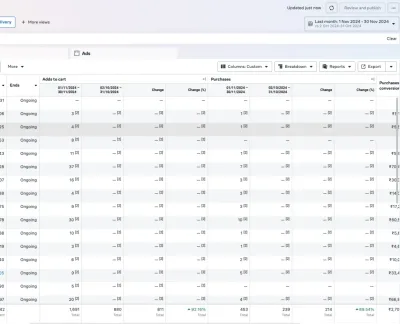
The brand could not scale without losing profitability. The first 30 days of the new funnel lifted adds to cart 92% and purchases 89%.
“A lot of custom development made it difficult to glean accurate insights through Google Analytics. They exceeded our expectations by finding a solution in half the time that other firms quoted us, and did so mostly independently, letting our team focus on the day-to-day.”
A Facebook ads agency plans, builds, and scales paid campaigns across Facebook and Instagram (Meta) to drive measurable revenue, not reach or engagement. Optimize Goal is a Facebook and Instagram ads agency for DTC ecommerce brands across the US, UK, and beyond: we run full-funnel Meta campaigns, feed them with weekly performance creative, and report ROAS tied to real revenue using the Conversions API, not Meta’s inflated in-platform numbers.
Your account is run by a senior Meta buyer, never handed off to a junior.
We optimize for ROAS and new-customer revenue, not vanity clicks and reach.
An in-house studio feeds your ad account fresh, tested creative every week.
Your Meta ad account, pixel, and data stay yours, always. Plus a live dashboard tying spend to real revenue.
One senior team running your entire Meta funnel against a single goal: profitable, trackable revenue for your store.
Audience and interest testing on Facebook and Instagram that finds new buyers and feeds the top of your funnel profitably.
Dynamic product retargeting and warm-audience campaigns that convert browsers into buyers and repeat customers.
Fresh statics, UGC, and video tested weekly in structured CBO campaigns so winning ads scale and losers get cut fast.
Methodical budget scaling on winning creative that grows spend while protecting your ROAS, no panic, no guesswork.
Instagram feed, Reels, and Advantage+ Shopping campaigns that put your products in front of high-intent buyers.
Conversions API, server-side tracking, and landing-page tests that fix attribution and lift the conversion rate your ads pay for.
Certified Meta Business Partner, running to Meta best practices.
We optimize to ROAS and CAC, not reach, impressions, or vanity numbers.
We work in Meta Ads Manager, Triple Whale, Northbeam, Motion, and your stack.
Meta ads bring the traffic. Email and SMS, CRO, and other channels make sure it converts and comes back, the full funnel a modern Facebook ads agency should support.
Klaviyo flows and campaigns that turn first-time buyers into repeat revenue.
Post-purchase flows and warm audiences that grow lifetime value, not just first orders.
On-store A/B testing and landing pages so more of your Meta traffic converts to sales.
Conversions API and blended reporting so you know what your Meta ads really drive.
We audit your Meta ad account, creative, and tracking, then show you exactly where spend is leaking and the size of the opportunity, usually within 48 hours.
You get an account structure, creative angles, and a spend-to-revenue forecast before a single dollar is committed.
We launch structured CBO campaigns and test creative and audiences to find profitable winners fast.
We scale winning creative, cut losers, and report ROAS tied to real revenue every week.
Apparel brand, scaled Meta spend $40k to $180k/mo
Supplements brand, full Meta account rebuild
Beauty brand, UGC creative testing engine
Home goods brand, landing-page CRO + Meta
Jewelry brand, scaled with Advantage+
Food & bev brand, retargeting + retention
We run every stage of your Meta funnel and weight budget toward what scales profitably, all tied back to ROAS.
Cold audience and interest testing that finds new buyers and feeds the top of your funnel.
Dynamic product retargeting that converts browsers and abandoned carts into buyers.
Meta Advantage+ Shopping campaigns that let the algorithm find your best buyers at scale.
Weekly statics, UGC, and video tested in structured CBO campaigns so winners scale.
Methodical budget scaling on winning creative that grows spend while protecting ROAS.
Conversions API and blended reporting so you know what your Meta ads actually drive.
Deep experience across the categories that win on Meta, so your strategy starts with proven category data.
Most Meta management retainers run $1,500 to $8,000 per month depending on ad spend. You always get a clear scope before anything starts.
Facebook and Instagram managed end to end for brands spending under $30k/mo.
Full Meta funnel with weekly creative testing for scaling brands.
Percentage-of-spend model for high-budget brands scaling fast on Meta.
One transparent monthly fee for Meta management. We scale spend only when the numbers justify it.
Every Meta ads advertising agency describes roughly the same service. These are the questions that separate them, and the answers worth insisting on.
| What to compare | What to look for | Common alternative |
|---|---|---|
| How results are reported | Blended ROAS and contribution margin against total store revenue | Platform-reported ROAS, where several campaigns claim the same order |
| Creative process | A weekly testing cadence with documented win and loss decisions | New creative when performance drops, produced reactively |
| Account structure | Consolidated so the algorithm gets enough conversion signal to learn | Many small ad sets, each stuck in the learning phase |
| Conversion tracking | Pixel plus CAPI, deduplicated and reconciled against real orders | Browser pixel only, quietly underreporting purchases |
| Who runs the account | A senior buyer who is in the account daily and whom you actually meet | A junior assigned after the pitch, behind an account manager |
| Commercial terms | Month to month, with your ad account and data in your own name | Long lock-in, and an ad account owned by the agency |
| Versus hiring in-house | A senior buyer plus an in-house creative team under one monthly fee | A senior buyer and a creative hire at $120k+ a year before tools, with one person's testing capacity |
For ecommerce brands spending at least $10k a month on Meta; below that, we will point you to the fixes worth making yourself.
Get my free Meta ads auditFor years, skill on Facebook meant assembling interest stacks and lookalike layers. Meta's optimization has since become better at audience selection than manual segmentation, and broad targeting with strong creative now routinely beats a carefully constructed audience with weak creative. That has moved the work rather than removed it: the ad itself is now the mechanism that selects who sees it, because the people who engage with a hook define the audience the algorithm goes looking for.
The practical consequence is that creative volume and a testing method matter more than almost anything else in the account. A brand producing three ads a quarter cannot find winners at the rate its costs rise, regardless of how skilled the buyer is. We test angles — problem-solution, social proof, founder story, demonstration, comparison — rather than variations on a single idea, because angle changes move performance in a way that a different button color never does. Results are read in Ads Manager and Motion by angle and hook, not ad by ad, so a pattern shows up before a single winner does.
Creative fatigue then has to be managed as a fact of the channel rather than as a surprise. Frequency climbs, hook rate falls, cost per acquisition drifts up, and the account looks like it is failing when it is simply running an ad the audience has already seen. A standing testing cadence means there is always a next winner in the queue, so replacement is scheduled rather than panicked.
The tracking restrictions introduced with iOS 14 did not stop conversions happening; they stopped Meta seeing a large share of them. For iPhone users who opted out, Meta fell back on Aggregated Event Measurement, which restricted and delayed the conversion data it could still report. The damage runs in two directions. Reporting understates what campaigns produced, so brands cut spend on things that were working. More seriously, the optimization itself degrades, because the algorithm learns which people to target from the conversions it receives — and it was receiving an incomplete, systematically biased sample.
The Conversions API addresses the mechanism rather than the symptom. Purchase events are sent from your server, where a browser's tracking prevention cannot intervene, and matched to the browser event through a shared event ID so a single order is counted once rather than twice. Done properly, event match quality rises, more purchases are attributed, and the algorithm is once again optimizing against something close to your real order list.
Done carelessly it creates the opposite problem, which is why implementation quality matters more than having CAPI at all. Missing event IDs produce duplicate conversions and inflated ROAS; poor parameter coverage produces low match quality and little benefit. We implement it against real orders, then reconcile Meta's reported purchases against what the store actually took before calling the setup finished.
Most brands hit a ceiling where more spend stops producing proportionate revenue. Usually nothing is broken; the account has simply exhausted the cheapest available demand, and each additional dollar now reaches someone less likely to buy. Recognizing that is the difference between scaling and burning budget: the constraint is normally creative supply or offer strength, not bid strategy.
This is also where platform ROAS becomes actively misleading. As spend rises, more of it goes to audiences that would have converted anyway — retargeting and branded demand — which report beautifully while adding little incremental revenue. The blended view exposes it: total spend against total store revenue, tracked against contribution margin, shows whether growth is real or whether the account has become efficient at taking credit.
Scaling decisions therefore run on blended numbers and on new-customer acquisition cost rather than on the campaign leaderboard. Budget goes up when the blended picture supports it and comes down when it does not, and we would rather tell a brand its ceiling is a creative problem or a margin problem than take a larger management fee on spend we know will not pay back.
Facebook ads management from a specialist agency usually costs $1,500 to $8,000 a month, paid on top of the budget that goes to Meta. Where a brand lands in that range depends on spend, on how much new creative the account needs each week, and on whether tracking has to be rebuilt before anything else. Our starter engagement covers Facebook and Instagram end to end for brands spending under $30k a month, growth management adds the full funnel with weekly creative testing, and high-budget brands scaling fast can move to a percentage-of-spend model, typically 10 to 20% of ad spend.
The fee should buy what one hire rarely covers on their own: a senior buyer in the account every day, a creative team turning out statics, UGC and video on a weekly cadence, and someone accountable for whether the Conversions API is actually counting orders. Building the same capability in-house means a senior buyer plus a creative hire, which runs to $120k+ a year before tools and production costs.
It is also worth saying when an agency is the wrong purchase. Below roughly $10k a month on Meta, a Facebook ads agency for small business budgets tends to consume too large a share of the money that should be buying customers, and the free audit will hand you the tracking fixes and creative direction to run the account yourself in Ads Manager. Above that level, ignore the lists ranking the best Facebook ads agency or the top Facebook ads agency of the year and judge the one in front of you on who runs the account, how results are reported and who owns the data. Location matters less than it seems: what a Facebook ads agency USA brands hire has to prove is that it can hold margin in some of the most expensive auctions Meta runs.
Campaign structure and budgets, creative testing and production, audience and exclusion setup, tracking integrity, and reporting. In practice the daily work is watching which creative is earning its spend and which is fatiguing, keeping conversion data clean so the algorithm optimizes correctly, and moving budget between what is working and what is not. The strategic work — offers, angles, funnel — happens in cycles around that. Both are run by the senior buyer you meet, not delegated after signing.
Most Meta management retainers run $1,500 to $8,000 per month depending on ad spend, and that is separate from the budget you give Meta. Brands spending under $30k a month typically sit in a starter engagement covering Facebook and Instagram end to end; larger accounts move to full-funnel management with weekly creative testing, and high-budget brands scaling fast can use a percentage-of-spend model instead. You get a clear scope before anything starts and there is no lock-in.
No — they are one system and managing them separately usually costs performance. Both run through Meta Ads Manager and share the same optimization and conversion signal, so splitting budget between them fragments the data the algorithm learns from. It is also why hiring a separate Instagram ads agency alongside your Facebook one rarely pays. Placement is treated as something Meta decides per impression, across Facebook and Instagram and increasingly Threads, WhatsApp's Updates tab and Audience Network, while the meaningful work is creative built to suit the surfaces it will appear on: Reels and Stories need a different treatment from a feed static, and an ad that ignores that gets shown less.
Enough to keep a live testing queue rather than a fixed quota, which in practice means a steady weekly cadence rather than a batch every quarter. The right volume depends on spend and how quickly your audience saturates — a brand spending heavily against a narrow audience burns through creative far faster than one spending modestly against a broad one. We produce statics, UGC and video in-house so volume is not gated by an external production schedule, and we test angles rather than minor variations.
Usually both, with Advantage+ carrying a significant share once the inputs are right. Advantage+ Shopping performs well when it is given clean conversion data and a strong pool of creative, and poorly when it is treated as a way to avoid doing either. Manual campaigns remain useful for controlled creative testing and for audiences you want to address deliberately. Meta has since folded Advantage+ Shopping into its Advantage+ sales campaign setup, so newer accounts may see it under that name; the principle is unchanged. The mix is an evidence question we settle in your account rather than a position to hold in advance.
On blended numbers. Platform ROAS is shown because bidding runs on it, but it is treated as an input rather than the result — Meta, Google and your email tool will each claim the same order, so the sum of platform-reported revenue routinely exceeds what the store actually took. We report total spend against total store revenue, alongside customer acquisition cost and contribution margin where you can share cost data, so the number in the report is one you could defend to a CFO. If you already run Triple Whale or Northbeam, the blended view is reconciled against it rather than rebuilt from scratch.
The Conversions API sends purchase events to Meta from your server rather than from the visitor's browser, so conversions survive the tracking prevention that browsers now apply by default. If you are spending meaningfully on Meta, yes, you need it — without it the platform sees an incomplete sample of your sales, which understates results and degrades optimization. It must be implemented with event IDs so browser and server events are deduplicated, otherwise it inflates reported conversions instead of correcting them.
Meta management makes sense once spend is high enough that a percentage point of efficiency exceeds the management fee, and for most ecommerce brands that starts in the low tens of thousands per month. Below that, the free audit will usually identify tracking fixes, creative direction and account structure changes that are worth more than ongoing management, and we would rather tell you that than take a retainer that consumes the budget it is supposed to be improving.
Yes, and Shopify is the most common platform we run Meta ads for, so if you need a Facebook and Instagram ads agency for Shopify store growth specifically, this is the core of the work. That matters mainly for tracking: CAPI tied to actual Shopify orders, catalog and feed setup for dynamic product ads, and event deduplication that accounts for the way Shopify's own pixel behaves. Because we also build and optimize Shopify stores, landing page and product page problems surfaced by the ads can be fixed rather than reported and left with you.
Audit findings arrive in 48 hours. Tracking and structural fixes often show up within the first two weeks, because they change what the algorithm can see rather than requiring it to learn something new. Creative-driven improvement builds over the following 30 to 60 days as tests conclude and winners scale. Any agency quoting a specific ROAS before seeing your account, margins and creative is guessing at a number they have no way to know.
You do, both. Campaigns run in your own Meta Business Suite and ad account, and if the engagement ends nothing needs migrating because nothing was held elsewhere. Creative produced during the engagement is yours to keep and keep using. An agency running ads from its own ad account has made leaving expensive by design, and that is worth checking before signing with anyone.
We always advise on them and we can build them. A great deal of what looks like an ad performance problem is a mismatch between the ad and the page it leads to — a promise made in the hook that the landing page does not restate, or a mobile page slow enough that a share of paid clicks never see it. We flag those as part of the work, and where a fix is a larger project our CRO and Shopify teams handle it rather than handing you a recommendation and moving on.
This page covers Meta specifically — Facebook and Instagram as a channel, run in depth. The ecommerce marketing engagement covers the whole growth system: Meta alongside Google, email and retention, and conversion work, budgeted across channels against one blended target. If what you want is one Google and Meta ads agency running both channels under the same team, that broader engagement is the fit. Brands whose growth is overwhelmingly Meta-driven usually want this focus instead, and the audit will tell you which you are.
It is a 30-minute working session, not a pitch. The senior buyer who would run your account walks through your Ads Manager, creative library and Pixel and Conversions API setup with you, and asks about margins and targets so the numbers can be read against profit. Within 48 hours you get written findings: where spend is leaking, which creative is fatiguing, what tracking is missing, and the account structure and creative angles we would start with. You keep all of it whether or not you hire us.
Very little. Partner access to your Meta ad account lets us look at real data instead of screenshots, and a rough idea of your gross margin and target acquisition cost lets us judge results against profit rather than platform ROAS. If you sell on Shopify, a view of order data for the same period helps us estimate how many purchases Meta is missing. There is no deck to fill in and no brief to write; bring the questions you actually want answered.
Judge an agency on its answers rather than its ranking. Find out who is in the account every day, and whether you meet that person before signing. Ask which number they report: Meta-claimed ROAS, or blended revenue and contribution margin. Ask how much new creative gets tested each week and who makes it. Then confirm the ad account stays in your own name. The best Facebook ads agency for you answers every one of those plainly and in writing, before any contract is on the table.
Yes, but they work differently. iOS 14 cut how much conversion data Meta receives, so accounts relying on the browser pixel alone saw reported results drop and optimization weaken at the same time. What brings performance back is not a targeting trick but better signal: the Conversions API sending purchases from your server, deduplicated against the pixel, plus broad enough targeting that the algorithm can work with the data it does receive. Judge the outcome on blended store revenue rather than Ads Manager alone, because some conversions will always go unreported.
For most ecommerce accounts with steady purchase data, broad targeting with strong creative now beats stacked interests, because Meta finds buyers from conversion signal better than a hand-built audience can. Meta's Andromeda update to ad retrieval pushed this further: it decides which ads are even considered for each person, and near-identical ads tend to be treated as one, so creative diversity now does the job interests used to. Interests still earn a place in controlled tests and in young accounts with little data, and excluding existing customers still matters.
Products that sell visually and can be understood from a short video, with gross margins wide enough to pay for a first order and repeat purchase to earn back the rest over time. Items that benefit from demonstration, before-and-after or social proof tend to scale fastest, because the creative does the persuading. Categories that depend on people already searching for them, or that combine thin margins with one-off purchases, usually find Google the better first channel. The audit will tell you plainly which of those describes your store.
Meta (Facebook and Instagram) is our core focus, but we also support Google, TikTok, and email so the whole funnel works together.
You’ll get audit findings in 48 hours. Expect a rebuilt account structure and first creative tests in 30 days, profitable winners by days 30 to 60, and a scale plan by day 90. We never guarantee a specific ROAS, any agency promising an exact number is a red flag.
No. We work month to month with no lock-in, and you keep full ownership of your Meta ad account and pixel. We’d rather earn your business with results than hold it with a contract.
Yes. Our in-house team produces statics, UGC, and video, and tests new creative every week so winners keep scaling, this is the core of Meta performance.
We use structured CBO testing campaigns to isolate winning creative, then scale budgets methodically on winners while cutting losers, protecting your ROAS as spend grows.
Yes. Beyond Meta ads we run Klaviyo email and SMS, conversion rate optimization, and creative, so the whole funnel works together.
Yes. We work with DTC ecommerce and Shopify brands across the US, UK, and other English-speaking markets.
Senior Meta buyers on every account, weekly in-house creative testing, profit-first optimization, and transparent reporting, with no lock-in contracts.
One in-house hire is stretched across buying and creative. An agency gives you a senior Meta buyer, an in-house creative team, and full tracking for less than a single senior salary.
We set up the Meta Conversions API and server-side tracking to recover signal lost to iOS 14+, then use blended reporting (Triple Whale or Northbeam) so your numbers reflect real revenue, not Meta’s overstated in-platform ROAS.
You work with a dedicated senior Meta buyer and a live dashboard, with a weekly written report so you always know how spend is performing.
Thirty minutes with a senior strategist, not a salesperson. You leave with the first three things we would change — and you decide what happens next.