Hair care · Shopify
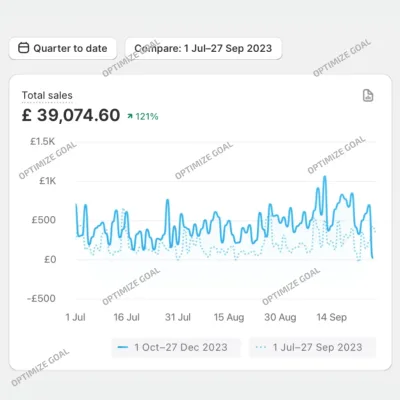
£5K to £39K in four months
Revenue had stalled. We fixed the site experience and launched UGC problem-solution ads — the quarter closed up 121% on the one before.
- 2.5x ROAS
- +121% QoQ

Book a free audit call and we will tell you which lever moves your numbers first.
Book a free auditFull-funnel ecommerce marketing services for DTC brands: Meta, Google, TikTok, email and CRO run as one system against blended MER and contribution margin. Senior buyers only, month to month. Book the free audit call and within 48 hours you see where profit is leaking and how big the opportunity is.
30 minutes · Built on your margins, not platform ROAS · Findings within 48 hours
Trusted by 50+ D2C brand founders


An ecommerce marketing agency is a specialist team that runs paid media, creative, email and conversion work for online stores, and is judged on profit metrics like blended ROAS (MER) and contribution margin rather than platform-reported ROAS.
An ecommerce performance marketing agency is the narrower version of that: paid acquisition run against unit economics rather than brand awareness. Optimize Goal is a DTC ecommerce marketing agency that sits in that lane. The ecommerce marketing services we run are full-funnel paid social on Meta and TikTok, Google and Shopping, in-house performance creative, Klaviyo email and SMS, plus CRO and AOV work — one senior team against one blended goal. We do not sell channels in isolation, because a store rarely has a Meta problem or a Google problem. It usually has a margin problem that shows up in one of them.
The reason profit-first matters here is arithmetic. Meta and Google each claim the same order, so platform-reported ROAS double-counts and the dashboard reads better than the bank account. Blended ROAS — also called MER, the marketing efficiency ratio — divides total revenue by total marketing spend, which is the honest number. What counts as a healthy MER depends entirely on your margin — a ratio that is comfortable for a high-margin product loses money on a thin-margin one — which is why we ask for unit economics before quoting a target rather than applying a benchmark. As a store scales, it becomes the metric that actually describes the business.
Choosing an ecommerce agency comes down to two things: who touches the account, and what they are told to hit. Every store here is run by a senior ecommerce buyer and never handed off to a junior, and that buyer manages to three numbers — blended MER, contribution margin per order (revenue minus COGS, shipping, fees and returns), and a CAC ceiling set from your real margins. Creative sits inside the same team, because creative is 70 to 80% of ecommerce ad performance and a stalled testing queue is a CPA that climbs.
What an e-commerce marketing agency costs is usually the next question. Most ecommerce retainers run $3,000 to $15,000 per month depending on spend and channels, separate from your ad budget, and we work month to month with a 30-day exit. Your ad accounts, creative and customer data stay yours. We take on 2 to 3 new partners a month so the work stays senior, and the first step is a free audit of your ad accounts, unit economics and store, with results usually within 48 hours.
We'd set your blended MER against contribution margin per order, check tracking and the store, and show where profit leaks and how big each fix is, usually within 48 hours.
Revenue had stalled. We fixed the site experience and launched UGC problem-solution ads — the quarter closed up 121% on the one before.
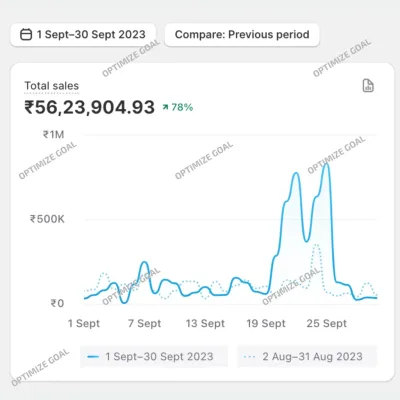
No funnel structure and a flat account. We rebuilt campaigns around a small set of offers and let the winners take the budget.
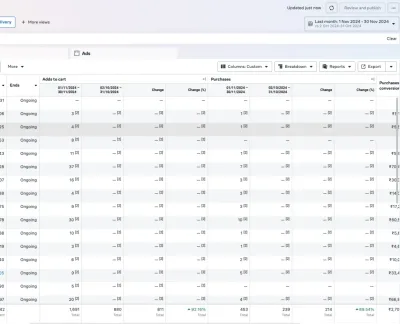
The brand could not scale without losing profitability. The first 30 days of the new funnel lifted adds to cart 92% and purchases 89%.
“A lot of custom development made it difficult to glean accurate insights through Google Analytics. They exceeded our expectations by finding a solution in half the time that other firms quoted us, and did so mostly independently, letting our team focus on the day-to-day.”
An ecommerce performance marketing agency scales DTC stores profitably, optimizing to blended ROAS (MER), contribution margin, and CAC, not platform-reported numbers. Optimize Goal is an ecommerce performance marketing agency for DTC brands across the US, UK, and beyond: we run full-funnel paid social, Google, and TikTok, back it with in-house creative, CRO, and retention, and manage to real profit on every order, not vanity ROAS.
Your store is run by a senior ecommerce buyer, never handed off to a junior.
We manage to blended MER and contribution margin, the metrics that reflect real store health.
An in-house studio feeds your store fresh, tested creative every week, 70% of performance.
Your ad accounts, creative, and customer data stay yours, always. Plus a live dashboard tying spend to real profit.
One senior team running your full funnel against a single goal: profitable, trackable revenue, measured on blended MER.
Full-funnel prospecting and retargeting on Facebook and Instagram, your highest-volume channel for new-customer acquisition.
Search, Performance Max, and Shopping that capture high-intent demand and feed your product catalog profitably.
Native, hook-driven video that reaches new audiences and drives first-order revenue at a profitable blended CAC.
Statics, UGC, and video tested weekly, creative is 70 to 80% of ecommerce ad performance, so we never let winners run dry.
Klaviyo flows and campaigns that turn first orders into repeat revenue and lift LTV, the other half of profitable scale.
On-store testing plus AOV levers, bundles, upsells, and free-ship thresholds, that lift the margin your ads pay for.
Meta Business and Google Partner, running to platform best practices.
We optimize to blended MER, contribution margin, and CAC, not platform-reported ROAS.
We work in Triple Whale, Northbeam, Klaviyo, Shopify, and your wider stack.
Paid ads bring first orders. Email and SMS, CRO, and retention make them convert and come back, because profitable DTC scale is won on LTV, not just CAC.
Klaviyo flows and campaigns that turn first-time buyers into repeat revenue.
Post-purchase flows and cohorts that grow lifetime value, the lever that lets you spend more to acquire.
On-store A/B testing and landing pages so more of your paid traffic converts to orders.
Server-side tracking and blended (MER) reporting so you know what really drives profitable revenue.
We audit your ad accounts, store, unit economics, and tracking, then show you exactly where profit is leaking and the size of the opportunity, usually within 48 hours.
You get a channel plan, creative angles, and a spend-to-profit forecast built on your real margins, before a dollar is committed.
We launch full-funnel campaigns and run structured creative and audience tests to find profitable winners fast.
We scale within your CAC ceiling, cut what loses money, and report blended MER and contribution margin every week.
Apparel brand, scaled $80k to $300k/mo profitably
Supplements brand, full-funnel rebuild
Beauty brand, TikTok + UGC creative engine
Home goods brand, AOV + bundling program
Jewelry brand, profit-first restructure
Food & bev brand, retention + LTV program
We run the full mix and weight budget toward wherever your store scales profitably, all tied back to blended MER and margin.
We set a blended MER target from your margins (healthy DTC is 3 to 5x at scale) and manage every channel to it.
Your CAC ceiling is the single most important guardrail in growth mode; we scale spend up to it, never past it.
We track contribution margin per order (revenue minus COGS, shipping, fees) so growth is profit, not just volume.
Bundles, upsells, and free-ship thresholds lift AOV, which improves ROAS and margin at the campaign level.
Retention and LTV by cohort let you spend more to acquire than competitors and still stay profitable.
Server-side tracking and blended reporting (not platform-inflated ROAS) so you know what actually drives profit.
Deep experience across the DTC categories that win, so your strategy starts with proven category margins and benchmarks.
Most ecommerce retainers run $3,000 to $15,000 per month depending on spend and channels, plus your ad budget. We work month to month with a 30-day exit. Clear scope before anything starts.
One core channel (Meta or Google) managed end to end, with creative and MER reporting.
Paid social, Google, and TikTok run together against one blended MER goal.
Full-funnel paid plus email/SMS, CRO, and creative for DTC brands scaling fast.
One transparent monthly fee. We scale spend only when your margins and CAC ceiling justify it.
Most DTC stores weighing a full-funnel retainer are comparing it with one of two alternatives: a first senior marketing hire, or a generalist agency that runs ecommerce alongside every other kind of client. The in-house call turns on cost, ramp time and creative volume; the generalist call turns on who is in the account and what they manage to. The table covers both.
| What to compare | Optimize Goal retainer | In-house hire or generalist agency |
|---|---|---|
| Annual cost | $3,000 to $15,000 a month, scoped in writing, separate from ad budget | In-house: a four-person team costs $300k+ a year before tools and spend |
| Time to first change | Audit findings in 48 hours; restructure and creative testing inside 30 days | In-house: months to recruit and ramp. Generalist agency: a template setup that never reads your margins |
| Who does the work | A senior ecommerce buyer daily, plus an in-house studio testing statics, UGC and video every week | In-house: one hire juggling every channel and every brief. Generalist agency: a junior on the account after the pitch |
| Metric managed to | Blended MER, contribution margin and a CAC ceiling from your real margins | Usually platform ROAS for both, which double-counts across Meta and Google |
| Channel coverage | Meta, Google, TikTok, Klaviyo, CRO and AOV run by one senior team | Depth in one channel, thin everywhere else as you add more |
| Tracking and attribution | Server-side tracking, CAPI and GA4 verified; blended reporting you can reconcile | Tracking gaps and messy attribution that nobody owns end to end |
| If it stops working | Month to month, 30-day exit; you own accounts, creative and data | In-house: salary and notice periods regardless of results. Generalist agency: whatever lock-in the contract set |
For DTC and Shopify brands spending at least $15k a month on ads, typically at $50k to $1M+ a month in store revenue.
Get my free ecommerce auditEcommerce marketing services are the acquisition, conversion and retention functions an online store needs to grow: paid media, creative, tracking, on-site conversion work and lifecycle email. Most e-commerce marketing solutions are sold as separate line items — a media agency here, a creative shop there, an email freelancer somewhere else — and each one reports its own win while nobody owns the blended number. We run them under a single target instead. Meta carries new-customer volume, Google Search, Shopping and Performance Max catch demand that already exists, TikTok adds reach where the creative earns it, and Klaviyo turns the first order into the second.
The on-site half decides whether any of it pays. CRO fixes the leaks in a funnel you are already paying to fill. AOV levers — bundles, upsells, free-shipping thresholds — raise the margin each order carries, which quietly improves ROAS at the campaign level. Retention and LTV by cohort are what let you outbid a competitor for the same customer and still bank the order. Marketing services for ecommerce that stop at the ad account leave most of the available profit on the table, which is why the scope here includes the store, not just the media.
Measurement holds the system together. Server-side tracking, Meta CAPI and GA4 are verified end to end, and blended reporting in Triple Whale or Northbeam gives the team one number to argue from. You get a live dashboard plus a weekly written report tying spend to blended MER and contribution margin. Scalable marketing services for ecommerce are not simply a bigger budget: they are a structure where every additional dollar has a known payback before it is committed, and a CAC ceiling that stops the scaling when it does not.
Most ecommerce retainers run $3,000 to $15,000 per month, or 10 to 20% of ad spend, depending on channels and scope, and that fee is separate from your ad budget. Where a brand lands in the range comes down to three things: how many channels are live, whether creative production is included, and whether the scope covers email, CRO and AOV work or paid media alone. Ranges like these are typical industry figures for context — your exact fee is scoped in writing before anything starts, so nobody discovers the real price in month three.
Fixed-fee and percentage-of-spend pricing pull in different directions. A percentage model pays the agency more when the budget goes up, which is an awkward incentive in a month when the right call is to spend less. A fixed monthly fee decouples our revenue from your budget, so cutting a channel that has stopped paying back costs us nothing. Ecommerce marketing packages that tie a defined scope to a flat fee are easier for a finance team to approve, easier to compare across agencies, and easier to leave when the work is not landing.
Compare it against the alternative honestly. A four-person in-house team costs $300k+ a year before tools, and a single generalist hire ends up stretched across paid media, creative, email and analytics with months of ramp before anything structural changes. For most DTC brands under roughly $10M in revenue, an agency is the cheaper route to a senior buyer, a creative studio and verified tracking at the same time. Above that, a hybrid — in-house strategy with agency execution — usually beats either option on its own.
An ecommerce optimisation agency works on the half of the equation that ads cannot fix: what happens after the click. Most stores we audit are not short of traffic. They are short of margin per session. The leaks repeat across accounts — a product page answering the wrong objection, a cart that reveals shipping cost too late, a mobile checkout losing a third of its starts, and a post-purchase flow that never asks for the second order. None of those are solved by raising a budget, and all of them make the media look worse than it is.
Ecommerce optimization services here mean testing rather than opinion. We work from analytics, session recordings and the audit findings, then run structured experiments on offers and messaging instead of button colours. Winning variants roll into the theme permanently, so each month's lift compounds on the last rather than resetting. Every experiment is scored in revenue per visitor against a fixed baseline, which is the only reliable way to know whether a change was worth shipping and what it is worth per month once it is live.
The same discipline runs upstream in the ad accounts. We set a CAC ceiling from your real margins and scale spend up to it, never past it — it is the single most important guardrail in growth mode. Budget moves toward whichever channel is paying back on a blended basis, not whichever platform reports the friendliest ROAS. Ecommerce performance is a margin question wearing a media costume, and treating it that way is what turns growth into profit you can bank instead of revenue you have to fund.
There is no best ecommerce marketing agency in the abstract, only the right one for your margins, your stage and the channel that is actually holding you back. Most ecommerce marketing agencies look identical on a shortlist, so screen on the things that are hard to fake. Ask which metric the agency will be held to, and get the answer in writing — an e-commerce agency that says “ROAS” without saying blended is telling you it optimises to the platform's scoreboard. Ask who is in the account daily, by name and seniority. Ask how many new clients they onboard each month, because capacity is the most honest signal of whether your account will get senior attention or a template.
Then check the exits, because the terms say more about an ecommerce marketing company than its case studies do. Ecommerce marketing agency reviews help here if you read them for how the relationship ran and how it ended, rather than for the headline ROAS. Long lock-in contracts, agency-owned ad accounts and creative you cannot take with you are all ways of making a mediocre quarter survivable for the agency rather than for you. We work month to month with a 30-day exit and you own the accounts, the creative and the customer data. Treat guarantees the same way: any agency promising a specific ROAS or revenue figure before it has seen your margins is selling a number it does not control.
Finally, match the scope to the stage you are at. A digital commerce agency that also builds storefronts is the right call mid-replatform; a specialist ecommerce advertising agency is the right call when the store converts and the media does not. Stores on Shopify should also check platform depth: a Shopify ecommerce marketing agency that can change the theme, the checkout tracking and the Klaviyo flows itself will move faster than one that files tickets with your developer. Optimize Goal is a certified Meta Business and Google Partner working with DTC ecommerce and Shopify brands across the US, UK and other English-speaking markets, full funnel, on blended numbers, with 2 to 3 new partners taken on a month so the work stays senior.
An ecommerce marketing agency typically costs $3,000 to $15,000 per month, or 10 to 20% of ad spend, depending on how many channels are live and whether creative, email and CRO are in scope. That fee sits separate from your ad budget. Ours is a fixed monthly amount scoped in writing before anything starts, billed month to month with a 30-day exit, so the price does not move simply because your ad budget did.
Agencies that optimize for MER rather than ROAS are the ones reporting a single blended number instead of adding up platform-reported conversions. Optimize Goal manages every account to blended ROAS (MER), contribution margin and a CAC ceiling built from your real COGS, shipping and fees. Platform ROAS double-counts, because Meta and Google both claim credit for the same order. If an agency cannot show MER on a weekly report, it is not managing to it.
For most DTC brands under roughly $10M in revenue, an agency wins on cost and ramp speed. A four-person in-house team costs $300k+ a year before tools, and one hire ends up stretched across paid, creative, email and analytics with months of ramp. An agency gives you a senior buyer, an in-house creative team and verified tracking for less than a single senior salary. Above that scale, in-house strategy with agency execution usually works best.
The ecommerce marketing services we run are full-funnel: paid social on Meta (Facebook and Instagram), Google Search, Shopping and Performance Max, TikTok, performance creative produced in house, Klaviyo email and SMS, CRO and AOV work, plus server-side tracking and blended reporting. Budget is weighted toward whichever channel pays back on a blended basis. We do not run channels as separate engagements with separate scoreboards, because that is how blended profit gets lost.
Ecommerce marketing is judged at the order rather than the lead. A B2B or services campaign ends at a form fill and hands off to sales; a store's campaign ends at checkout, so every figure can be measured in revenue, margin and repeat purchases. That changes the work: product feeds and Shopping campaigns, creative tested against purchase data, on-site conversion and AOV, and email flows that bring customers back. It also changes the risk, because platform ROAS can look healthy while contribution margin shrinks. An agency that never asks for your COGS is not managing to that risk.
Our ecommerce marketing packages come in three shapes. Single-channel management covers one core channel, Meta or Google, end to end with creative and MER reporting. Full-funnel management runs paid social, Google and TikTok together against one blended MER goal. A growth partnership adds Klaviyo email and SMS, CRO and creative for brands scaling fast. Each is a fixed monthly fee agreed up front, and if none fits we scope a custom one rather than stretch a package.
Most clients working with us spend at least $15k a month across paid channels, typically at $50k to $1M+ a month in store revenue, and we manage accounts from $10k to $500k a month in spend. Below that range, the free audit will tell you honestly whether paid media is the right next step. We will not push you to scale before the unit economics support it, because unprofitable volume helps neither of us.
Not as a rule. We are a D2C ecommerce marketing agency, and the creative, tracking and margin models here are built for stores selling straight to consumers. Wholesale portals, quote-driven catalogs and trade accounts are judged on pipeline and sales-team follow-up rather than blended MER, so a B2B ecommerce marketing agency, or our B2B performance marketing service, is the better fit. Brands that sell both ways are a different case: if the consumer side carries the growth target, the audit call will show whether we can help.
It can, and niche products have some advantages: a smaller audience that is easier to reach precisely, objections specific enough to answer directly in creative, and search terms that are less contested. What decides it is margin per order, repeat-purchase potential, and whether demand already exists on Google or has to be created on Meta and TikTok. The free audit checks those three against your numbers. If the audience is too small to scale into at a profitable CAC, we will tell you before you commit to a retainer.
You get audit findings within 48 hours. Expect an account restructure and the first creative testing sprints inside the first 30 days, profitable winners emerging between days 30 and 60, and a clear scale plan by day 90. Tracking and structural fixes usually show up in the numbers within about two weeks. We never guarantee a specific ROAS or revenue figure, and any agency promising “4x ROAS” before seeing your margins is a red flag.
We make it. Creative is 70 to 80% of ecommerce ad performance, so an agency asking you to supply everything is handing the biggest lever back to you. Our in-house team produces statics, UGC and video and tests new angles weekly, so winners never run dry and CPAs do not creep while a testing queue sits idle. You own every asset produced, and it stays yours if the engagement ends.
No. We work month to month with a 30-day exit and no lock-in, and you keep full ownership of your ad accounts, creative and customer data. We only take on 2 to 3 new partners a month, which is what keeps a senior ecommerce buyer on every account rather than a rotating junior. We would rather keep the work by performing than by holding you to a twelve-month term you regret in month four.
Yes. E-commerce email marketing sits inside the same team rather than a separate retainer. We build Klaviyo flows and campaigns — welcome, browse and cart abandonment, post-purchase, winback — plus SMS, so first orders turn into repeat revenue. Retention is what raises LTV, and LTV is the lever that lets you spend more to acquire a customer than a competitor can and still stay profitable on the first order.
Attribution starts with the plumbing: server-side tracking, Meta CAPI and GA4 verified end to end, so events survive iOS changes and ad blockers. Reporting then runs blended, in Triple Whale or Northbeam, rather than summing platform-reported conversions that double-count the same order. We are direct about incrementality. The goal is a revenue number you can reconcile against Shopify, not one that flatters the ad accounts at the end of the month.
An ecommerce optimisation agency works on conversion and margin rather than media volume: product pages, cart and checkout, offers, AOV levers and retention. We do that work, but inside the same engagement as paid media, because separating them is how brands end up with an agency blaming the site and a developer blaming the ads. Experiments are scored in revenue per visitor against a fixed baseline, and winners are rolled into the theme permanently.
Yes. We work with DTC ecommerce and Shopify brands across the US, UK and other English-speaking markets. The playbook itself does not change by geography — blended MER, contribution margin and a CAC ceiling built from your real margins — but CPMs, shipping costs and return rates do. So the targets we set are built from your market's actual numbers rather than a benchmark borrowed from somewhere else.
Usually not. Searching for an ecommerce marketing agency near me makes sense when you need a product shoot, but the marketing itself happens inside your ad accounts, Shopify admin, Klaviyo and a shared dashboard, so proximity matters far less than who is in the account every day. We work with DTC brands across the US, UK and other English-speaking markets. If you are shortlisting an ecommerce marketing agency in the USA, judge the weekly report, the contract terms and the audit findings rather than the zip code on the invoice.
A good ecommerce marketing partner names the metric it will be accountable to before it quotes you, tells you who is in the account daily, caps how many clients it onboards a month, and lets you leave. Ask to see a weekly report template. Ask whether creative is produced in house. Whether you hire an agency or an ecommerce marketing consultant, treat guaranteed ROAS numbers, agency-owned ad accounts and long lock-ins as reasons to keep looking.
Yes, it is free, and no retainer is attached to it. The call takes 30 minutes. Beforehand, share view access to your ad accounts and a rough cost per order covering COGS, shipping and fees, because the audit is built on unit economics rather than platform ROAS. We review ad accounts, store, tracking and margins, then send findings with the size of the opportunity, usually within 48 hours. If paid media is not the right next step for your store yet, the findings will say so plainly.
Yes. We focus exclusively on DTC ecommerce and Shopify brands, so our creative, tracking, margin models, and playbooks are built for online stores, not generic lead gen.
You’ll get audit findings in 48 hours. Expect a restructure and creative testing in the first 30 days, profitable winners by days 30 to 60, and a clear scale plan by day 90. We never guarantee a specific ROAS or revenue number, any agency that promises “4x ROAS” or “$1M in 90 days” is a red flag.
We optimize to blended ROAS (MER), contribution margin, and CAC, built on your real COGS, shipping, and fees, using server-side tracking and tools like Triple Whale. Platform-reported ROAS overstates results, so we manage to numbers you can actually bank.
Yes, and it’s essential, creative is 70 to 80% of ecommerce ad performance. Our in-house team produces statics, UGC, and video and tests new angles weekly. An agency that asks you to supply all creative is a red flag.
We run Meta (Facebook and Instagram), Google and Shopping, and TikTok, plus email and SMS, then weight the mix toward wherever your store scales most profitably on a blended basis.
Yes. Beyond paid ads we run Klaviyo email and SMS, CRO, and AOV work (bundles, upsells, thresholds), because profitable DTC scale needs the whole funnel, not just acquisition.
Yes. We work with DTC ecommerce and Shopify brands across the US, UK, and other English-speaking markets.
We manage to profit (blended MER and contribution margin), not platform ROAS; senior ecommerce buyers on every account; weekly in-house creative; full funnel including retention and AOV; and transparent reporting, with no lock-in.
An agency, for most DTC brands under ~$10M in revenue. One in-house hire is stretched across paid, creative, email, and analytics and takes months to ramp; an agency gives you a senior buyer plus an in-house creative team and full tracking for less than a single senior salary, productive in weeks.
You work with a dedicated senior ecommerce buyer and a live dashboard, with a weekly written report so you always know how spend is performing against profit.
Thirty minutes with a senior strategist, not a salesperson. You leave with the first three things we would change — and you decide what happens next.