Hair care · Shopify
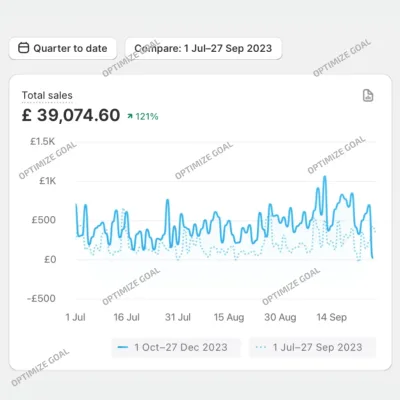
£5K to £39K in four months
Revenue had stalled. We fixed the site experience and launched UGC problem-solution ads — the quarter closed up 121% on the one before.
- 2.5x ROAS
- +121% QoQ

Book a free audit call and we will tell you which lever moves your numbers first.
Book a free auditShopify web design and development on Online Store 2.0: a custom theme when you genuinely need one, smart customization of a modern theme when you do not, and clean Liquid with a Core Web Vitals budget on every template either way. Book a free 30-minute storefront review for a straight custom-or-customize answer and a fixed quote within 48 hours.
30 minutes · Custom build only if you need one · Fixed quote within 48 hours
Trusted by 50+ D2C brand founders


A Shopify web development agency designs and builds the storefront your customers actually see — themes, sections, product page templates and the Liquid behind them — and keeps that front end fast, accessible and easy to change after launch.
The first decision a Shopify web design agency makes for you is worth more than everything that follows: whether you need a custom theme at all. A bespoke Online Store 2.0 theme built from scratch runs $8,000 to $50,000+, takes longer, and costs more to maintain for the life of the store. Shopify theme customization — new sections, a rebuilt product page, branded styling on a modern theme — runs $600 to $8,000 and gets most stores somewhere very close to the same place. Most brands do not need the custom build. Agencies rarely volunteer that, because the custom build is the larger invoice.
Where a custom theme does earn its cost is when the brand experience is genuinely the product: unusual merchandising, a configurator, an editorial layout no section-based theme can express, or a scale of content that needs its own architecture. That is a real category and we build for it. It is simply much smaller than the number of quotes issued for it.
In Shopify website development the build itself is Liquid, and the quality of that Liquid is what you live with. Online Store 2.0 changed what good looks like — JSON templates, sections everywhere, metaobjects for structured content — and a store built to that standard lets your marketing team rearrange pages without a developer. A store built as one hard-coded template, or assembled in a page builder that ships a rendering engine to every visitor, needs a developer for every change and gets slower with each one.
Then there is speed, which on Shopify is a revenue number rather than a technical one. Mobile is where most storefront traffic converts or fails to, and Largest Contentful Paint on a phone is decided by image handling, render-blocking scripts and how many apps have injected themselves into the page. We put a Core Web Vitals budget on every template and hold the build to it, because a site that tests well on a desktop in the studio and stalls on a phone in a shop is not finished.
We check which templates carry your revenue, what your apps cost in load time and how mobile performs, then say customize or rebuild, with a fixed quote in 48 hours.
Revenue had stalled. We fixed the site experience and launched UGC problem-solution ads — the quarter closed up 121% on the one before.
“A lot of custom development made it difficult to glean accurate insights through Google Analytics. They exceeded our expectations by finding a solution in half the time that other firms quoted us, and did so mostly independently, letting our team focus on the day-to-day.”
Optimize Goal is a Shopify web development agency for DTC and ecommerce brands across the US, UK, and beyond. We build custom Online Store 2.0 themes, write clean Liquid, integrate apps and APIs, and back every build with rigorous QA and conversion-focused engineering. From Shopify web design to full custom development, our Shopify web developers ship fast, conversion-focused storefronts. Every build ships with technical SEO fundamentals — clean markup, fast Core Web Vitals, and structured data — so your store is ready to rank.
Your build is led by a senior Shopify developer, never handed off to a junior.
We engineer every site for page speed and conversion, not just how it looks in a demo.
We write tidy, well-documented Liquid on Online Store 2.0 your team can extend later.
We will tell you honestly when a customized OS 2.0 theme beats a costly custom build.
One senior team handling every part of your website build, from Liquid to launch, against a single goal: a fast, reliable site that converts.
Bespoke Online Store 2.0 themes built from your designs (or ours), pixel-perfect, fully responsive, and tuned for conversion.
Custom sections, PDP overhauls, and branded styling on a modern theme, 90% of a custom build at a fraction of the cost.
Custom Liquid, JSON templates, and metaobject schemas, plus bug fixes and refactors that clean up messy, slow themes.
Custom apps and Storefront / Admin GraphQL API integrations that add the exact functionality your site needs.
Migration from legacy Vintage themes to Online Store 2.0 (Dawn, Horizon, custom), no lost content, SEO, or speed.
Core Web Vitals tuning, Liquid clean-up, and on-store A/B tests that lift your conversion rate and search rankings.
Shopify Partner, building to Online Store 2.0 and platform best practices.
Semantic Liquid and modern JS, built for Online Store 2.0 and beyond.
We integrate Klaviyo, Recharge, Gorgias, Yotpo, and your wider stack.
Launching the site is the start. Maintenance, new sections, integrations, and performance work keep it fast and stable, the full lifecycle a modern Shopify web development agency should own.
Retainer support, Liquid bug fixes, and updates so your site never falls behind.
Subscriptions, reviews, 3PLs, and APIs wired cleanly into your Shopify site.
On-store A/B testing and UX fixes so more of your traffic converts to sales.
Ongoing Core Web Vitals and speed work that protects rankings and revenue.
We dig into your goals, designs, and current site, then send a fixed-scope quote and the right-sized approach, usually within 48 hours.
You get wireframes, a technical plan, and a build timeline before a single line of Liquid is written.
We build on a staging theme you can review, with structured QA across devices and browsers before anything goes live.
We launch with a full pre-flight checklist, then stay on for support, fixes, and new sections as you grow.
Apparel brand, full custom theme build
Supplements brand, OS 2.0 theme migration
Beauty brand, custom theme + Liquid build
Home goods brand, theme customization
Jewelry brand, speed & Core Web Vitals
Food & bev brand, app integration build
We build and develop Shopify websites of every size, always recommending the approach that fits your budget and goals, tied back to speed and conversion.
Bespoke Online Store 2.0 themes built from scratch when you need a uniquely branded site.
Custom sections and PDP overhauls on a modern theme, the smart-budget route for most stores.
Custom Liquid, JSON templates, and metaobjects for the functionality off-the-shelf themes miss.
Storefront and Admin GraphQL API work, plus clean third-party app integrations.
Upgrade legacy Vintage themes to Online Store 2.0 with no lost content, SEO, or speed.
Liquid clean-up and Core Web Vitals tuning that protect both rankings and revenue.
Deep experience across the categories that win on Shopify, so your build starts with proven category patterns.
Theme customization runs $600 to $8,000; custom theme builds from scratch run $8,000 to $50,000+. Most stores do not need a full custom build, we will tell you honestly. Fixed quote before any work begins.
Custom sections, PDP overhauls, and branded styling on a modern OS 2.0 theme.
Bespoke Online Store 2.0 theme built from scratch for a uniquely branded site.
Retainer for new sections, Liquid fixes, integrations, and speed work as you grow.
One transparent monthly retainer for ongoing Shopify web development, with a senior team on call.
This is the decision that sets your budget, your timeline and how much every future change costs. It is worth making deliberately rather than by default. For most stores the right base is a premium theme such as Prestige, or Shopify's own Dawn or Horizon, customized properly rather than replaced.
| What to compare | Customizing an OS 2.0 theme | Custom theme from scratch |
|---|---|---|
| Typical cost | $600 to $8,000 depending on how much is rebuilt | $8,000 to $50,000+ depending on complexity |
| Who it suits | Most stores — the visual result is close and the money goes further | Brands whose experience is genuinely unusual and central to the product |
| Time to launch | Weeks, because the foundation already exists and is proven | Longer, because everything is designed and built before anything is testable |
| Ongoing maintenance | Theme updates come from the theme author; you maintain your additions | You own every line forever, including the parts nobody has looked at since launch |
| Performance baseline | Starts from a theme already tuned for Core Web Vitals | Whatever the build achieves — good if budgeted for, poor if treated as polish |
| Risk | Low — you can see the base working before committing to changes | Higher, and concentrated at the end when the budget is already spent |
For Shopify brands weighing a redesign, a theme migration or a custom theme quote, from $600 customization work up to $50,000+ builds, who want a second opinion first.
Get my free storefront reviewShopify store design decisions are conversion decisions, so they should be made against how the store actually sells rather than against a mood board. Before any Liquid is written we want to know which templates carry the traffic, where mobile users drop out, what the product page has to explain before someone will buy, and which merchandising the team changes often enough that it must not need a developer.
That last question shapes the architecture more than anything aesthetic. Sections and metaobjects exist so that content your team edits weekly lives in the theme editor, not in code. Getting the boundary right — what is a flexible section, what is a fixed template — is the difference between a site the marketing team can run and a site that needs a ticket for every campaign.
In practice the design work runs in four steps. Plan: which templates carry revenue, what the product page has to explain, and which content the team edits weekly. Wireframe: layout and section boundaries agreed before any visual design, so the architecture is settled while it is still cheap to change. UI design: brand styling applied to real product data, mobile first. Build and launch: clean Liquid on a staging theme you can open throughout, then QA and a launch checklist before anything is published.
As a Shopify website design agency we can work from your Figma files or handle design ourselves. Either way the output is the same: a responsive build that matches the design on real devices, not just at the three breakpoints the mockup was drawn at, with the states designers usually leave out — empty carts, long product titles, sold-out variants, error messages — specified rather than improvised.
Stores still on a Vintage theme are working with a materially worse toolkit. No sections on templates other than the homepage, no JSON templates, no metaobjects, no app blocks — which means apps inject themselves through script tags instead of installing cleanly, and every layout change is a code change. The gap widens with each Shopify release, since new features increasingly assume Online Store 2.0.
The migration is a rebuild of the front end rather than a switch, and the risk is content. Section content, metafields, navigation, custom templates and anything a previous developer hard-coded all have to be accounted for and mapped, or the new theme launches missing things nobody notices until a customer does. We inventory the old theme first, map every piece of content to its new home, and build on a staging theme you can compare side by side before anything is published.
URLs and metadata carry over unchanged because the theme layer does not own them, which makes this considerably lower-risk for search than a platform migration. What can change is speed and structured data, and both usually move in the right direction: a well-built Online Store 2.0 theme typically loads faster than the Vintage theme it replaced, and Core Web Vitals feed into how the store ranks.
Every marketing dollar spent driving traffic to a slow storefront is partially wasted, and the waste scales with spend. On mobile connections the gap between a fast store and a slow one is not a fraction of a second, it is the difference between a session and a bounce — and it compounds, because a store that converts better can afford a higher cost per click and outbid competitors for the same traffic.
Most Shopify speed problems come from a short list of causes: unoptimized images, apps loading scripts on every page whether or not that page uses them, render-blocking fonts and JavaScript, and page builders that ship a layout engine to the browser. None of these are mysterious, and all of them are cheaper to prevent during a build than to unpick afterwards, which is why a performance budget belongs in the scope rather than in a later optimization project.
We hold builds to a Core Web Vitals budget per template and test on throttled mobile rather than on studio hardware. Where an app is costing more in load time than it returns in function, we say so — removing one is sometimes the single largest conversion improvement available, and it is not a change most agencies are incentivized to suggest.
Discoverability now includes AI answers as well as blue links: Google AI Overviews and assistants such as ChatGPT read product pages much as a crawler does, then decide whether to cite them. Shopify design for AI search is mostly the fundamentals done properly — Product structured data carrying price, availability, variants and reviews; collections organized around how buyers describe what they want; product pages that state materials, sizing and use cases in text rather than only in images; and fast, server-rendered pages. The same clean product data feeds Google Merchant Center, so feed-ready product pages pay off twice.
A freelance Shopify web developer is the right answer for well-defined, bounded work: a section to build, a bug to fix, a template to adjust. The economics are better and the communication is direct. The exposure is concentration — one person's availability, one person's judgment, and no second pair of eyes on QA. The same logic applies to hiring a Shopify web designer on their own: a strong designer hands over files, and someone still has to turn them into Liquid that performs on a phone.
An agency earns its premium on work where a failure costs real revenue: a full storefront build, a theme migration, anything launching into a peak trading period. You get design, development and QA as separate disciplines rather than one person switching between them, cover when someone is unavailable, and a review process that catches the mobile bug before your customers do.
The question worth asking either way is what you inherit. Ask to see Liquid from a recent build, ask who maintains it after launch, and ask what happens if you take the store elsewhere in a year. A Shopify web development agency confident in its work will show you the code and the staging theme without being pushed — clean, documented Liquid is a claim that is easy to verify and awkward to fake.
We will work on a store that uses one, and we will usually recommend moving off it. Page builders solve a real problem — letting a marketing team build pages without a developer — but they solve it by shipping a rendering layer to every visitor, which costs load time on exactly the mobile devices where conversion is decided. Online Store 2.0 sections and metaobjects give your team the same editorial freedom natively, with no runtime cost, so the usual path is to rebuild the pages that matter as native sections and retire the builder.
Less than most teams expect. To scope accurately we want access to the current store, an idea of which pages carry your traffic and revenue, any brand or design assets you already have, and a list of the apps and integrations that must survive the build. Designs are helpful but not required — we can build from your Figma files or handle design ourselves. From that, scoping produces a fixed quote and a milestone plan, usually within 48 hours.
This page covers Shopify web design and development for the storefront — themes, sections, Liquid and front-end performance, the part customers see. Our broader Shopify development service covers the whole platform build, including custom apps, third-party and ERP integrations, replatforming from WooCommerce or Magento, and Shopify Plus work. If your project is a website design, a redesign or theme customization, you are in the right place; if it is a migration or a custom app, that service is the better fit and the same senior team does both.
Yes, and it is frequently the better use of a budget. Traffic and revenue on a Shopify store concentrate heavily in a few templates — usually the product page, collection page and cart. Rebuilding those properly while leaving the rest of the theme alone delivers most of the available gain for a fraction of a full redesign, and it lets you measure the effect of each change instead of launching everything at once and guessing which part worked.
Shopify website redesign cost depends on how much of the theme actually changes. Reworking the templates that carry most of the revenue — usually the product page, collection page and cart — on a modern theme sits in the $600 to $8,000 customization range, depending on how much is rebuilt. A full redesign on a custom Online Store 2.0 theme runs $8,000 to $50,000+. Stores still on a legacy Vintage theme usually need the Online Store 2.0 migration folded into the redesign, and the fixed quote says so up front.
A theme redesign is one of the lower-risk changes you can make for search, because the theme layer does not own your URLs or product metadata, so both carry over unchanged. What a careless Shopify redesign agency can break is content — hard-coded sections, metafields and custom templates nobody mapped — along with structured data and page speed. We inventory the old theme before building, check structured data on the staging theme, and hold every template to a Core Web Vitals budget, so rankings have reasons to improve rather than slip.
On a staging theme you can open at any point, and on real devices rather than browser emulation. QA covers the templates and states that break most often — long product titles, sold-out variants, empty carts, discount codes, error messages — across the browsers and phones your analytics show your customers actually using. We also test on a throttled mobile connection, since a build that only performs on studio hardware and office wifi has not been tested under the conditions that matter.
Theme customization projects usually run a few weeks depending on how much is rebuilt. A full custom Online Store 2.0 theme takes longer, since design, architecture and build all happen before anything is testable. You get a milestone schedule with the fixed quote, generally within 48 hours of the scoping call, and a staging theme you can open throughout so progress is visible rather than reported.
Yes. We write custom Liquid, JSON templates and metaobject schemas for functionality off-the-shelf themes do not cover, and we build custom apps and Storefront or Admin GraphQL API integrations where a store needs behavior no app provides. We are equally willing to remove app bloat — a store carrying several apps that each inject scripts on every page is usually paying for them twice, once in subscription and once in load time.
Headless builds on Hydrogen and Oxygen sit with our Shopify development team, and we scope one when a fully custom front end is genuinely needed. For most storefront projects it is not: a well-built Online Store 2.0 theme ships sooner, keeps the theme editor your marketing team relies on, and gets close to the same Core Web Vitals without a separate front-end codebase to host and maintain. If someone has already recommended headless to you, the storefront review is a cheap place to test that advice before you fund it.
Yes. We integrate Recharge, along with Klaviyo, Gorgias and Yotpo, as part of storefront builds. On the theme side that means subscribe-and-save options on the product page that are clear about price and frequency, a cart that handles one-time and subscription items together, and a customer portal styled to match the rest of the store. Where an app supports app blocks we install it that way rather than through script tags, so the subscription feature does not add load time to pages that never use it.
Usually both, and the real question is whether they work as one team. A Shopify web designer decides layout, hierarchy and how the product page sells; a Shopify web developer turns that into Liquid, sections and templates that stay fast on a phone. Hiring them separately works when the handover is tight, but the gaps — empty carts, sold-out variants, long titles, breakpoints nobody drew — land between the two. A Shopify web design agency covers both roles, so those gaps are someone's job from the start.
You do, completely. The theme lives in your Shopify account, the code is documented, and you can take it to another developer at any point without a handover negotiation. We build on the assumption that you might: clean, conventional Liquid that another developer can read is the standard, rather than a bespoke structure that quietly makes us difficult to replace.
We build to accessibility best practices — semantic markup, sufficient color contrast, keyboard navigation, focus states and proper labeling — and can run an accessibility audit on an existing store to identify what needs attention. No agency can responsibly promise blanket legal compliance, since that depends on content you add after launch as well as on the theme, but the build should not be the thing standing in the way.
We audit what each app costs in load time against what it contributes, and present that as a list you can decide from. Apps are the most common cause of a slow Shopify storefront, partly because many load scripts on every page whether or not that page uses their feature, and partly because uninstalled apps often leave code behind in the theme. Cleaning up orphaned app code and consolidating overlapping tools is frequently the cheapest speed work available on an established store.
Yes, and catalog size changes the design brief. Large catalogs succeed or fail on collection structure and filtering: collections organized around how buyers actually shop, filters driven by clean product data through Shopify Search & Discovery, and metafields and metaobjects that keep specifications consistent instead of buried in descriptions. Product and collection templates then have to hold up at the extremes — products with many variants, missing images, very long titles — not just for the tidy sample product the mockup was drawn around.
Shopify connects to those marketplaces through sales channel apps: Google & YouTube for Google Merchant Center and free listings, TikTok for TikTok Shop, and Marketplace Connect for Amazon. Each channel reads product data from Shopify, so the storefront work that matters sits upstream — clean titles, complete variant options, GTINs, good images and accurate inventory. We structure that data during the build so it serves the product page and the feeds alike; running paid campaigns on those channels is a separate engagement with our Google Shopping ads team.
Every build ships with a support window, and most brands keep a light retainer for new sections, Liquid fixes, integrations and ongoing Core Web Vitals work. Stores decay without attention: apps get added, images get uploaded unoptimized, and speed drifts down over a year until someone notices conversion has followed it. A small amount of scheduled maintenance costs far less than the rebuild that eventually replaces a neglected theme.
Yes. We work as a Shopify web design agency for USA, UK and other English-speaking DTC brands on Shopify and Shopify Plus. Copy, currency, date formats and market-specific requirements are handled during the build rather than retrofitted, and where a brand sells into several regions we set up Shopify Markets so the storefront presents correctly in each rather than approximating.
It is a 30-minute call and it costs nothing. We look at which templates carry your traffic and revenue, how the store performs on mobile, and which apps are loading scripts on pages that never use them. You get a straight recommendation on customizing your current theme versus building a custom one, with the reasoning, and within 48 hours a fixed quote and milestone plan. If the honest answer is a few targeted fixes rather than a redesign, that is what we quote.
Yes. We focus exclusively on Shopify and Shopify Plus, so our themes, Liquid, apps, and integrations are built specifically for the platform.
Theme customization (custom sections, PDP overhauls) runs $600 to $8,000; a custom theme built from scratch runs $8,000 to $50,000+; retainers start at $2,000/month. Most stores do not need a full custom build. You get a fixed quote first.
Most stores do not need a custom theme from scratch. A modern Online Store 2.0 theme (Dawn, Horizon, Prestige) with thoughtful customization gets you ~90% of a custom build’s value at a fraction of the cost. We will tell you honestly which you need, that is a red flag to watch for in other agencies who upsell custom builds by default.
Yes. We build for Core Web Vitals and clean, semantic Liquid markup, so your site loads fast and stays search-friendly out of the box.
Yes. Most builds are quoted as fixed-scope projects so you know the cost upfront. Ongoing work runs on a flexible monthly retainer.
Yes. We build from your Figma or design files, or our team can handle design too. Either way you get a pixel-perfect, conversion-focused build.
Yes. We upgrade legacy Vintage themes to Online Store 2.0 (Dawn, Horizon, or a custom theme), so you get JSON templates, sections everywhere, and app blocks, with no lost content or SEO.
Senior developers on every build, clean and maintainable Liquid, honest budget advice (we will not upsell a custom build you do not need), conversion and speed engineered in, full QA, and post-launch support.
A freelancer suits small, well-defined Liquid tasks. For a full website build or redesign where quality and speed matter to revenue, an agency gives you a senior team, dedicated QA, a clear point of contact, and post-launch support.
You work with a dedicated project lead plus the senior developer on your build, with a live staging theme and clear milestones so you always know the status.
Thirty minutes with a senior strategist, not a salesperson. You leave with the first three things we would change — and you decide what happens next.